
Who Pays for Car Damage in Florida No-Fault?
The Property Damage Guide for Orlando Drivers
By Attorney Juan C. Burgos, Esq. | Serving Orange, Osceola, Seminole & Polk Counties
TL;DR / Direct Answer: Florida's "no-fault" law does not cover property damage — it only covers bodily injuries through Personal Injury Protection (PIP). When another driver damages your car, their Property Damage Liability (PDL) insurance pays for your vehicle repairs. Florida law requires every driver to carry a minimum of $10,000 in PDL (§ 627.7275, Fla. Stat.). If the at-fault driver is uninsured or their coverage falls short, your own Collision or Uninsured Motorist Property Damage (UMPD) coverage becomes your safety net.
If you were recently rear-ended on Interstate 4 near downtown Orlando, sideswiped on Orange Blossom Trail, or T-boned at an intersection on Colonial Drive, one question is almost certainly running through your mind: who is responsible for fixing my car? Because Florida is a "no-fault" state, most drivers assume their own insurance automatically handles everything. This is one of the most expensive misconceptions in Florida auto law — and it affects thousands of Orange County drivers every year.
Florida "No-Fault" Only Applies to Your Body — Not Your Car
Florida's no-fault system is built around Personal Injury Protection (PIP), codified in § 627.736 of the Florida Statutes. PIP requires every driver to carry a minimum of $10,000 in coverage that pays for your own initial medical bills and a portion of lost wages — regardless of who caused the crash. That is what "no-fault" means: for medical expenses, you go through your own insurer first.
Property damage operates under an entirely different rule. Florida is a fault-based state for vehicle damage. The driver who caused the accident is legally responsible for repairing or replacing your car. Every registered driver in Florida must carry a minimum of $10,000 in Property Damage Liability (PDL) (§ 627.7275, Fla. Stat.) — coverage that pays for damage they cause to other people's vehicles and property.
⚠️ Common Mistake: Calling your own insurer and asking them to fix your car after someone else hits you. Unless you have Collision coverage, your insurer will tell you to file a claim with the at-fault driver's PDL policy. Skipping this step costs accident victims time, money, and leverage.
Who Pays for What — Complete Florida Auto Coverage Breakdown
Understanding which policy responds to which type of loss is the foundation of every Florida property damage claim. Use this reference table when you're deciding how to proceed after a crash:
| Coverage Type | Who Pays? | What It Covers | Required in FL? |
|---|---|---|---|
| Property Damage Liability (PDL) | At-fault driver's insurance | Repairs to your vehicle, rental car, damage to other property | Yes — $10k min |
| Personal Injury Protection (PIP) | Your own insurance | Your initial medical bills (80%) and lost wages (60%) | Yes — $10k min |
| Collision Coverage | Your own insurance | Repairs to your car when the at-fault driver is uninsured/underinsured | Optional |
| Uninsured Motorist PD (UMPD) | Your own insurance | Your vehicle damage when the at-fault driver has no insurance | Optional |
| Bodily Injury Liability (BIL) | At-fault driver's insurance | Compensation for injuries, pain and suffering, lost wages beyond PIP | Optional |
ACV vs. Repair Cost: When calculating whether to pay for repairs or declare a total loss, insurers compare repair costs against the vehicle's Actual Cash Value (ACV). If repair costs approach or exceed ACV, they will total the vehicle and offer ACV minus any applicable deductible.
How to Get Your Car Fixed After an Orlando Crash — Step by Step
Call 911 and obtain a Florida Traffic Crash Report.
For any crash involving injury or significant property damage in Orange County, call 911. The responding officer will file a crash report. Request the report number before leaving the scene.
Document everything at the scene.
Photograph the damage to all vehicles, capture license plates, skid marks, and document road conditions. Get the names, contact information, and insurance policy numbers from the other driver.
Notify your own insurance company — but do not admit fault.
Florida policies require you to notify your insurer of any accident. Provide factual information only. Do not give a recorded statement to any insurer without first speaking with an attorney.
File a third-party property damage claim with the at-fault driver's insurer.
Contact the at-fault driver's insurance company and open a PDL claim. The insurer will assign an adjuster who will inspect your vehicle and estimate damages.
Exercise your right to choose your own repair shop.
Under Florida Statute § 626.9743, insurers cannot require you to use a particular repair shop or location. You have the right to select the repair facility of your choice, and an insurer cannot reduce your coverage or delay your claim because you didn't pick their "preferred" shop.
Demand a rental car or transportation allowance.
The at-fault driver's PDL covers reasonable rental car costs while your vehicle is being repaired or while you are waiting for a total-loss settlement.
Consider consulting an attorney before accepting any settlement.
Once you accept a settlement check, you typically release them from further liability. If you have a diminished value claim or undiscovered damage, accepting early can permanently waive those rights.
The Florida $10,000 PDL Problem
Florida's $10,000 Property Damage Liability minimum is one of the lowest in the country, and it hasn't kept pace with what vehicles actually cost to replace. The average transaction price for a new vehicle now runs well above $40,000. This math creates a systematic shortfall that leaves thousands of Orlando drivers covering catastrophic losses out of pocket every year.
Real-World Scenario: A $32,000 SUV Totaled on Semoran Boulevard
A driver runs a red light and T-bones your SUV, valued at $32,000. The at-fault driver carries Florida's state minimum: $10,000 in PDL. Their insurer pays their limit. You're legally owed the remaining $22,000 with no automatic insurance coverage to collect it from unless you have Collision, UMPD, or an attorney who can investigate additional sources of recovery (like umbrella policies or commercial coverage).
What Happens If the At-Fault Driver Has No Insurance?
Roughly one in five Florida drivers operates without valid insurance — among the higher uninsured-motorist rates in the country. When you're hit by an uninsured driver, your options depend entirely on your own policy:
Option A: Collision Coverage
If you have Collision, your own insurer pays for repairs regardless of the other driver's status. You pay your deductible upfront, but your insurer will pursue the uninsured driver directly (subrogation) and return your deductible if successful.
Option B: UMPD Coverage
Uninsured Motorist Property Damage (UMPD) pays for your vehicle damage when the at-fault driver has no insurance. It often comes with a lower deductible than Collision, though hit-and-run claims typically require evidence of actual physical contact.
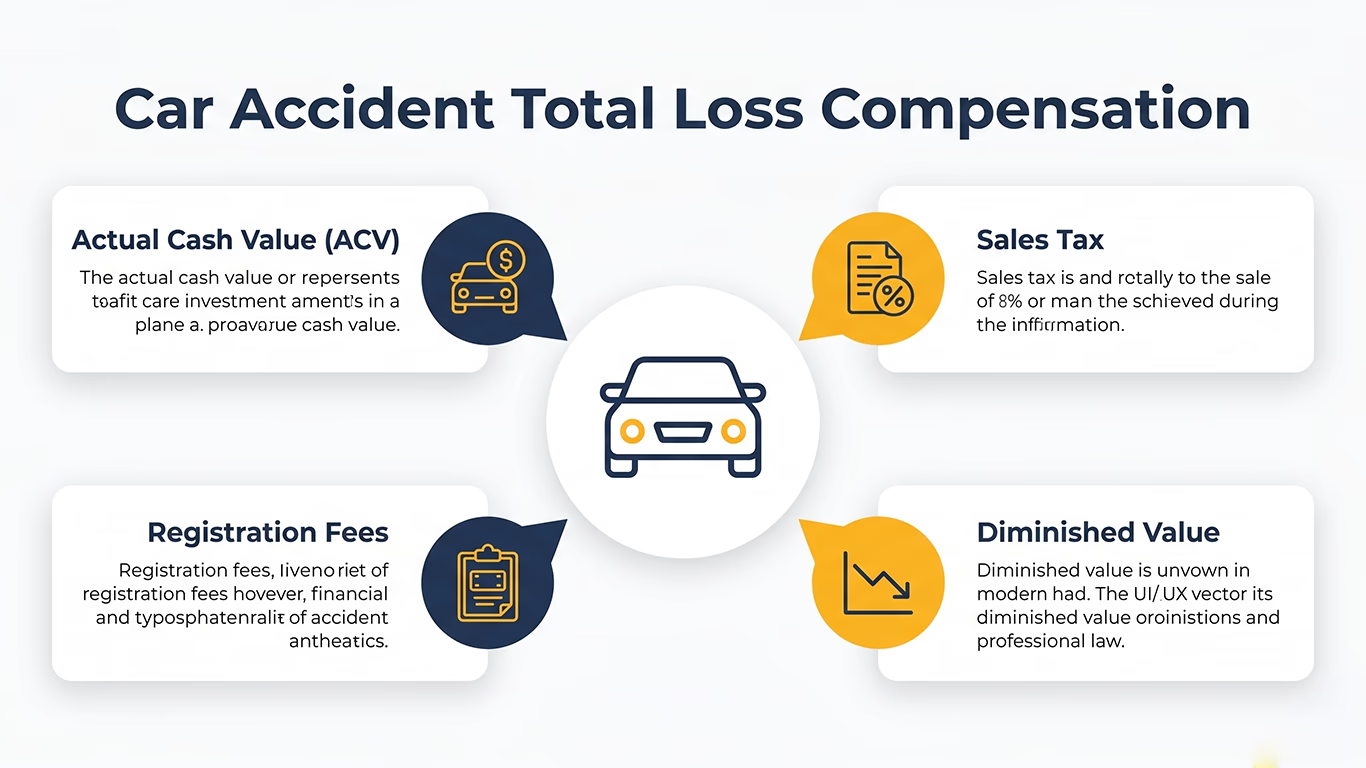
Total Loss in Florida — What You're Actually Owed
| Component | What You're Owed |
|---|---|
| Actual Cash Value (ACV) | Fair market value of the vehicle at the time of the crash. You can dispute an ACV offer with comparable local listings. |
| Sales Tax | Florida sales tax (6%) on the ACV settlement when the vehicle is being replaced. |
| Registration Fees | Reimbursement for replacement vehicle title transfer and registration costs. |
| Diminished Value | Compensation for the reduction in your car's resale value after repairs. Florida allows third-party diminished value claims against the at-fault driver's insurer — Florida courts have held that first-party claims against your own insurer can be excluded by policy language. |
Mistakes That Cost Orlando Accident Victims Thousands
- Giving a recorded statement: The adjuster is trained to capture admissions that reduce your claim. You are not legally required to give one to the other driver's insurer.
- Accepting a lowball ACV offer: Initial total loss offers are routinely 10–20% below actual market value. Pull comparable listings in Central Florida to counter-offer.
- Forgetting to claim a rental car: You are entitled to reasonable rental car reimbursement. Many people absorb this cost unnecessarily.
- Missing the statute of limitations: Under Florida law, property damage negligence claims are subject to the same 2-year statute of limitations that applies to injury claims, for crashes on or after March 24, 2023.
Frequently Asked Questions
Who pays for my rental car after a Florida car accident?
The at-fault driver's PDL insurance is responsible for your rental car costs. If the insurer delays, you may use your own rental reimbursement coverage temporarily and seek reimbursement once fault is established.
Can I choose my own repair shop in Orlando?
Yes. Under Florida Statute § 626.9743, insurers cannot require you to use a particular repair shop or location. Insurance companies can recommend shops, but they cannot force you to use their "preferred" partners.
What is a diminished value claim?
A diminished value claim compensates you for the reduction in your vehicle's market value after an accident, even after it's fully repaired. Florida allows third-party diminished value claims against the at-fault driver's liability insurer, though Florida courts have held that insurers can exclude these claims from first-party policies against your own insurer.
Does Florida require Uninsured Motorist coverage?
No, but it's highly recommended. Because roughly 1 in 5 Florida drivers is uninsured, UM/UMPD coverage protects you if an at-fault driver lacks insurance to repair your vehicle.
Insurance Adjusters Work for the Insurance Company — Not You
Let our legal team handle the adjusters, fight for the fair value of your vehicle, and protect your right to medical compensation.
Legal Disclaimer: This article is for general informational purposes only and does not constitute legal advice. The 2023 HB 837 tort reforms introduced significant changes to Florida negligence law — consult a licensed Florida attorney for guidance on your specific situation.