

Quick answers
Behind on the electric, water or gas bill in Orlando, Kissimmee or Sanford? Start here.
Can Chapter 7 wipe out my utility bills?
Yes, for the balance you owed before you filed. Once your case ends with a discharge, you no longer owe that old amount, and the utility can't collect it. How Chapter 7 treats old utility bills
Can the utility shut off my power after I file?
Not because of the old debt or because you filed. But you have 20 days after filing to give the utility a deposit or other security for future service, and if you miss that deadline it can shut you off. If your power is already off, call us right away. The 20-day deadline
Do I still have to pay anything?
Every bill for service after you file is yours to pay on time, and the utility may ask for a deposit. Plan for that money before you file. Help you can try before you file
How long does it take?
In most Chapter 7 cases the discharge comes about four months after filing. The automatic stay that stops collection starts the day you file. What to expect, step by step
What should I never do?
Never leave a utility off your list, pay back a friend or relative right before filing, or ignore a deposit letter. The full lists
Why so many Central Florida households are behind
Power bills in Florida have climbed fast, and plenty of local families are falling behind. The numbers in recent news coverage show why.
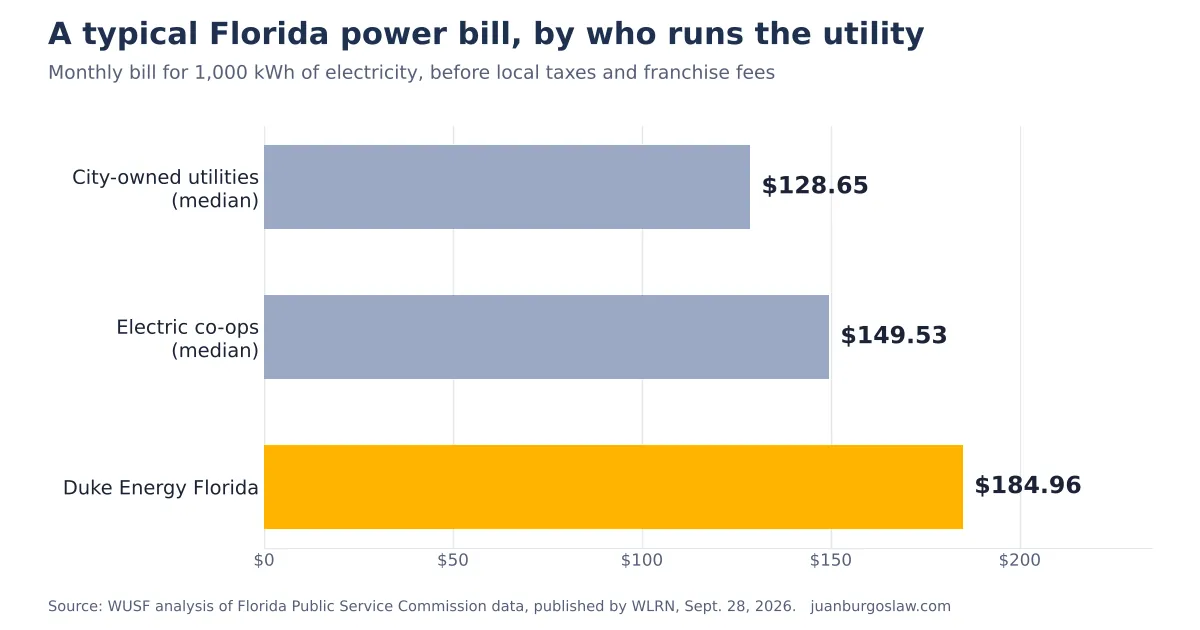
A September 2026 WUSF analysis, published by WLRN, found that a typical Duke Energy Florida bill rose from $108 to $185 since 2016, about 70%. Tampa Electric (TECO) customers pay roughly 60% more than they did then. The same analysis ranked TECO's average residential bill eighth highest in the country for 2025.
Hurricane costs added to the pile. TECO charged customers a storm restoration surcharge after Hurricanes Idalia, Debby, Helene and Milton, and WFTV reported that it ended on August 1, 2026, taking about $19.95 off a typical 1,000 kWh month. That helps. Bills are still far above where they were a few years ago.
Then there are shutoffs. A new federal report from the U.S. Energy Information Administration found Florida homes had their electricity cut about 2.1 million times in 2024 because of unpaid bills, according to Inside Climate News. That is roughly 90 disconnections for every 1,000 residents.
In Orlando, the Orlando Utilities Commission board approved its PeakSHIFT pricing program in December 2024. Central Florida Public Media reported that part of it, called DemandLevel, charges tiered fees based on how much power a home pulls from the grid, with a start date planned for March 2026. Some residents and county officials worried it would hit seniors and lower-income households hardest. If you are an OUC customer, look at your own statement to see how it applies to you.
Frustration has reached city halls too. FOX 13 reported that St. Petersburg leaders considered spending $590,000 to study leaving Duke Energy for a city-run utility.
If you are behind, you are not alone. The next sections show what bankruptcy can and can't do about it.
What Chapter 7 does to old utility bills
A past-due electric, water or gas bill from before you file is an unsecured debt, in the same group as most credit card balances. When your Chapter 7 case ends with a discharge, you no longer owe it personally. After that, the utility can't try to collect it by calling, billing you for it or suing you.
The moment you file, the automatic stay also kicks in, which stops most collection activity right away. And under 11 U.S.C. § 366(a), a utility can't cut off or refuse your service just because you filed or because you owed a past bill.
Chapter 7 does not cover power you use after you file. Those bills are yours, and you have to keep paying them on time.
The 20-day deadline most people don't know about
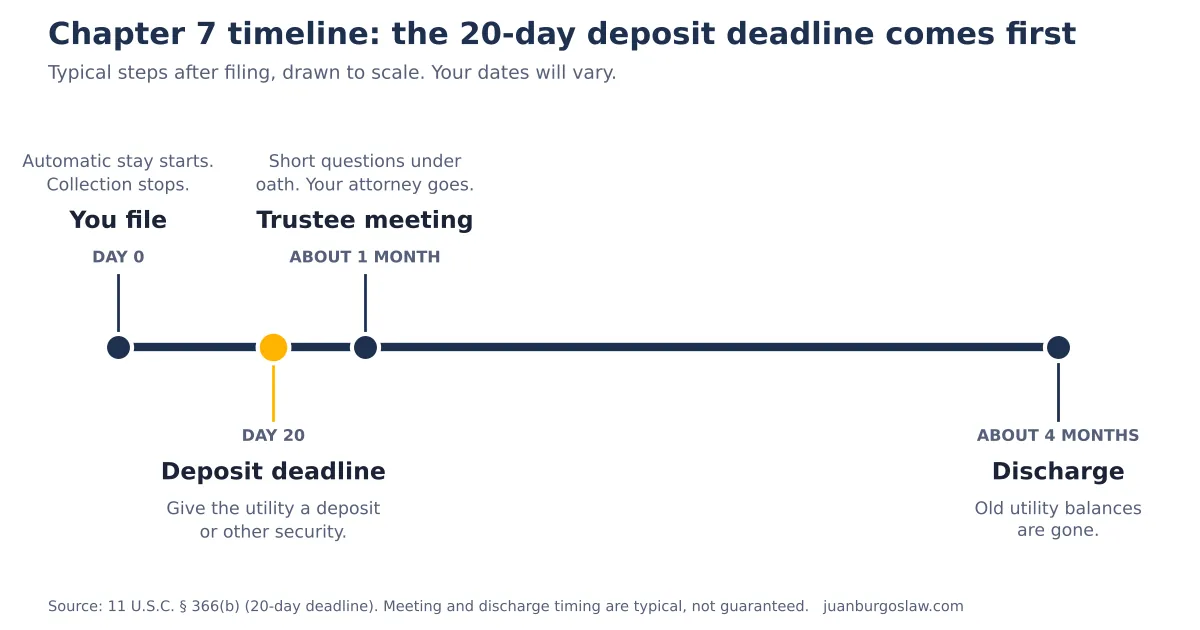
This catches families off guard. After you file, the utility can shut off service if you don't give it a deposit or other security within 20 days. Mark the date on your calendar the day you file.
How much can they ask for? For companies regulated by the state, like Duke Energy Florida and TECO, the rules start with the utility's approved tariff. Florida Administrative Code Rule 25-6.097 says a utility can ask for a deposit on an existing account with at least 30 days' written notice, and that a residential deposit is refunded after 23 months of continuous service with a good payment record.
If the amount is too high for your budget, the bankruptcy court can change it. Section 366(b) lets a judge order a "reasonable modification" of the deposit after notice and a hearing. Your lawyer can ask the utility for a smaller amount first and go to the judge if it says no.
The practical lesson is to plan for the deposit before you file. Most of the local assistance programs listed below do not pay deposits.
What to expect, step by step
- You meet with a bankruptcy attorney and list every debt, including every utility, even small ones.
- You complete a short credit counseling course before filing. The law requires it.
- Your attorney checks whether you qualify using the means test. You can try our Florida Means Test Calculator first.
- Your case is filed and the automatic stay begins. Your attorney sends notice to your creditors, including the utilities.
- Within 20 days, you deal with any deposit request from your electric, water or gas provider.
- About a month after filing, you attend a short meeting with the bankruptcy trustee, who asks you questions under oath about what you listed. Your attorney goes with you.
- In most Chapter 7 cases, the discharge arrives around four months after filing. The old utility balances are gone.
Do and don't
Do these things
- Gather your last few bills from every utility and bring any shutoff or past-due notice with you.
- Tell your attorney if the power or water is already off. Call as soon as you can.
- List every utility, even ones you owe only a little to.
- Keep paying the new, post-filing bills on time, every month.
- Set aside money for a deposit before you file, if you can.
- Tell your attorney about any deposit you already paid a utility, since it may count toward what they ask for.
- Read every letter from a utility after you file, and send it to your attorney the same day.
Never do these things
- Don't leave a utility off your list because the balance seems small. Every creditor has to be listed.
- Don't pay back one creditor, a relative for example, shortly before filing without asking an attorney. The trustee can undo some of those payments.
- Don't run up credit cards or take a payday loan just to pay the electric bill right before filing. That can cause serious problems in your case.
- Don't sell or give away property to avoid losing it. The trustee reviews recent transfers.
- Don't ignore a letter asking for a deposit. The 20 days run whether you read the letter or not.
- Don't stop paying for service you use after filing. Chapter 7 does not cover it.
- Don't spend a charity grant on an old utility bill you were about to discharge. Talk to your attorney first.
Homeowners and renters
If you own your home
If you own your home and live in a city with its own water, sewer or gas system, check for a lien. Under Florida Statute 159.17, a city that issued revenue bonds can have a lien on the property for unpaid water, sewer or gas charges, and it can foreclose after 30 days of delinquency. Chapter 7 erases your personal duty to pay, but a valid lien on the house can survive. If you have a large water or sewer balance, tell your attorney early. In some of these cases Chapter 13 can fit better.
If you rent
Renters have some protection too. Florida Statute 180.135 says a city can't refuse service to a new tenant, or the owner, over unpaid charges a former occupant ran up. Your own past-due balance is still your debt, and it can be discharged in Chapter 7. If you stay in the same place, you still have to deal with the 20-day deposit rule.
Help you can try before you file
Bankruptcy is not always the first step, and some help is worth knowing about. Check each program's current rules, because funds run out.
- OUC customers in Orange and Osceola counties can apply through Heart of Florida United Way for Project CARE, up to $500 once per household in 12 months, for overdue bills only. It does not cover deposits.
- Duke Energy customers in Orange, Osceola and Seminole counties can apply through the same United Way page, limited to twice in a 12-month period. Winter Park and Winter Garden utility customers can get up to $650.
- Orange County's LIHEAP program offers crisis help of up to $1,000 per fiscal year for households under the income limit, such as $61,837 a year for a family of four. You generally need a past-due or disconnection notice. The hotline is (407) 836-7429.
- You can also call 211 to ask about other local help.
Is Chapter 7 right for you?
Most people don't file bankruptcy over a single utility bill. It tends to make sense when the electric bill sits on top of credit cards, medical bills or other debt you can't realistically repay. If that sounds like your situation, a free consultation can show you where you stand.
Talk to Juan Burgos Law Offices in Orlando
We help Central Florida families in Orange, Osceola and Seminole counties sort out Chapter 7 and Chapter 13 cases, and we handle them in English, Español and Português. If a shutoff notice is on your table, don't wait for the deadline.
1339 Arlington St, Orlando, FL 32805
This article is general information, not legal advice, and reading it does not create an attorney-client relationship. Every case is different, and laws, utility rules and assistance programs change. Past results do not guarantee a similar outcome.
Sources (12)
- WUSF via WLRN: What's behind the high electricity bills crushing Floridians? (Sept. 28, 2026)
- WFTV: Tampa Electric ends storm surcharge Aug 1 (July 29, 2026)
- Inside Climate News: Florida Electricity Shutoffs Rank Among Nation's Highest (April 2026)
- Central Florida Public Media: Controversial Orlando Utilities Commission pricing program passes (Dec. 11, 2024)
- FOX 13 Tampa Bay: St. Pete rising power bills spark $590K feasibility study vote (June 2026)
- 11 U.S.C. § 366, utility service
- 11 U.S.C. § 727, discharge and § 524, effect of discharge
- 11 U.S.C. § 362, automatic stay
- Fla. Admin. Code R. 25-6.097, customer deposits
- Fla. Stat. § 159.17 and § 180.135
- Heart of Florida United Way: utility assistance
- Orange County: Energy Bill Assistance (LIHEAP)