
Can I File Bankruptcy Without a Lawyer in Florida?
A 2026 Look at Pro Se Filing in the Middle District of Florida — and Where DIY Petitions Go Wrong
By Attorney Juan C. Burgos | Updated July 2026 | Serving Orange, Osceola, Seminole & Polk Counties
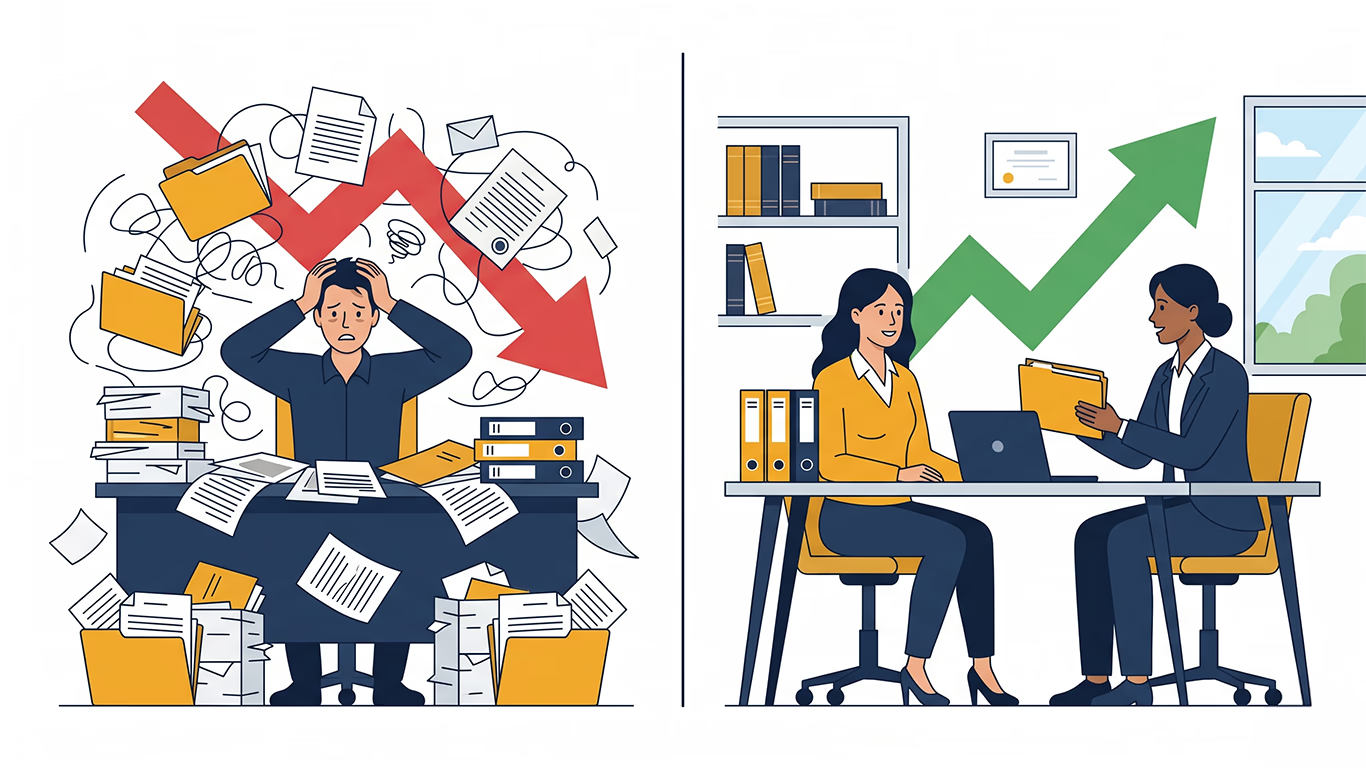
The short version: You are allowed to file your own bankruptcy in Florida — it is called filing “Pro Se.” The problem is not permission, it is outcome. In national studies of Chapter 13 cases, only about two or three filers out of a hundred who go it alone actually reach a discharge. The rest are dismissed, run into the Means Test, or lose property they were legally entitled to keep because they never claimed the right Florida exemptions. The filing fee is the cheap part; the mistakes are where it gets expensive.
When money is tight, the question makes complete sense: “Why not just fill out the forms myself and keep the attorney fee?” Sometimes that is a reasonable call. A straightforward Chapter 7 with no property, no house, and income well under the Florida median is about as close to “simple” as bankruptcy gets. But that is a narrow lane. Most weeks, someone walks into the Orlando bankruptcy court on their own and leaves in worse shape than when they started — not because they did anything dishonest, but because they did not know what they were giving up. This is a plain-English rundown of what actually goes wrong, so you can decide for yourself.
Why the Numbers Are So Lopsided
The most-cited research on this comes from academic studies of federal bankruptcy outcomes and from the American Bankruptcy Institute, which has written bluntly that a Chapter 13 filed without an experienced attorney is close to a guaranteed failure. Here is what those numbers look like in practice:
- Chapter 13, without a lawyer: studies put the discharge rate somewhere around 2 to 3 percent. Roughly half of pro se cases are tossed within three months of filing, and the large majority are gone within six. A plan that a trustee will actually confirm has a lot of moving parts, and a missed payment or a technical defect ends it fast. Learn how the process is supposed to work on our Chapter 13 page.
- Chapter 7, without a lawyer: the danger here is different. Chapter 7 is shorter and the paperwork is lighter, but that is not the same as safe. The real risk is a trustee selling something you could have protected — a tax refund, a paid-off car, or equity in a second property — because the exemptions were claimed wrong or not claimed at all.
Three Ways DIY Bankruptcy Tends to Backfire
The stories rhyme. Someone underestimates the complexity, files paperwork that is incomplete or filled out wrong, and loses something they had every right to keep. These are the three we see most often:
1. Thinking you can back out
A lot of people assume that if it gets messy, they can just cancel. You usually can’t. The day you file a Chapter 7 petition, your non-exempt property becomes part of the bankruptcy estate and the trustee is in charge of it. If the trustee spots something worth selling — a pending inheritance, a tax refund, or vehicle equity above Florida’s exemption — you do not get to dismiss the case just to pull that asset back out. Once it is on the trustee’s radar, the decision may no longer be yours.
2. Getting the Means Test wrong
Chapter 7 runs through the Florida Means Test. If your household income is under the state median (for cases filed on or after April 1, 2026, that is $68,085 for a single filer), you generally pass and move on. Above it, you have to run a second, more involved calculation built on IRS-allowed expense standards. That second step is where DIY filers slip — one wrong figure can draw a challenge from the U.S. Trustee’s office and get the case dismissed.
3. Leaning on a “notario” or form preparer
Paying a non-attorney petition preparer or notario is common in Central Florida, and it is easy to see why. But federal law is clear: they cannot give you legal advice. They can type what you tell them — they cannot tell you which exemptions to use, cannot appear at your hearing, and are not on the hook if the petition is wrong. You are. Bankruptcy is a federal court case, not a form you drop in the mail.
What an Attorney Is Actually For
Hiring Juan Burgos Law is not about paying someone to fill in blanks. It is about having someone whose job is to protect what you own at each step:
| What we do | Why it matters |
|---|---|
| Plan your exemptions first | We apply Florida’s exemptions to your car, home equity, bank accounts, and tax refund before anything is filed, so the trustee has nothing left to claim. |
| Run the Means Test correctly | We work through the calculation and the IRS expense deductions that pro se filers routinely leave on the table, so your eligibility holds up. |
| Stand with you at the 341 meeting | We get you ready for the Meeting of Creditors — now held by Zoom in the Middle District of Florida — and are on the call when the trustee questions you under oath. |
| Answer creditor objections | If a creditor challenges your filing, we respond and defend your right to a discharge in court instead of leaving you to argue it alone. |
Worried about the fee? We offer payment plans built for families in Central Florida, and the first conversation is free. You do not need money in the bank to sit down and get a straight answer about where you stand.
Frequently Asked Questions
Can I legally file bankruptcy by myself in Florida?
Yes. Filing “Pro Se” — representing yourself — is allowed in federal bankruptcy court. The catch is that the court holds you to the same rules and deadlines as a licensed attorney, and the judge and clerks are not permitted to give you legal advice if you get stuck.
How much does it cost to file bankruptcy in Florida without a lawyer?
The court filing fee is $338 for Chapter 7 and $313 for Chapter 13. You can ask to pay in installments, and Chapter 7 filers whose income is below 150% of the federal poverty line can apply to have the fee waived entirely. Attorney fees are separate and depend on how complex your case is.
What is the Florida Means Test and do I have to pass it?
It is a federal income calculation that decides whether you qualify for Chapter 7. If your income is under the Florida median for your household size, you generally pass automatically. If it is over, a second expense-based calculation kicks in. You can run a free estimate with our Florida Means Test Calculator.
What happens at the 341 Meeting of Creditors in Florida?
The 341 meeting is a short, required hearing where the trustee puts you under oath and asks about your income, assets, and petition. In the Middle District of Florida these are now conducted by Zoom video, and you will need to verify your identity with a government-issued photo ID and proof of your Social Security number ahead of time. If you have an attorney, they attend the meeting with you.
Can I lose my car or house if I file bankruptcy in Florida?
Florida’s exemptions are strong. The homestead exemption can protect unlimited home equity if you meet the acreage and ownership requirements, and Florida Statute § 222.25(1) protects up to $5,000 of equity in a single vehicle (raised from $1,000 effective July 1, 2024). If you are not claiming the homestead exemption, an additional $4,000 “wildcard” can be applied to other property — and stacked on a vehicle. If your equity is above what the exemptions cover, that overage can be at risk in Chapter 7, which is exactly why the exemptions should be mapped out before you file.
Get a Free, Honest Read on Your Case
We’ll tell you plainly whether your situation needs an attorney or is simple enough to handle on your own. No pressure, no obligation. We also serve Orange, Osceola, and Seminole counties.
Legal Disclaimer: Bankruptcy is a federal legal proceeding with lasting consequences — a dismissed case or a lost asset can follow you for years. This article is general information about Florida and Middle District of Florida practice as of July 2026; laws, fees, and income figures change. It is not legal advice and does not create an attorney-client relationship. Talk to a qualified Florida bankruptcy attorney about your specific situation.